|
|
|
|
Home > Teeth: A Very Short Introduction 1st ed
|
Most Helpful Customer Reviews:
Add Your Own Review |
 An OK introduction..., April 30, 2015 An OK introduction..., April 30, 2015
By Stephen Armstrong
|
|
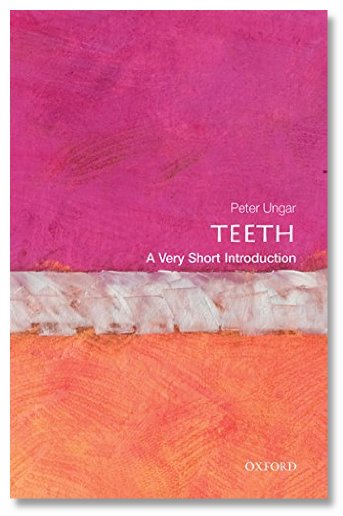
This is a straightforward book about teeth and their significance in vertebrate evolution. Other topics included the structure of teeth, their development from embryo to adult, the designations of cusps and ridges, and so forth. It was well written but pretty dry. I did not find the micrographs of embryo teeth bud development helpful in visualizing exactly how the buds developed.
So, it wasn't a bad book, just pretty descriptive and not so analytic. For instance, I was left curious about why enamel developed in the first place, and exactly where on the evolutionary tree it evolved; and more about the physical measurements of enamel. Also, exactly how did dentistry evolve?
Another book may be more interesting to the reader: Neil Shubin's Your Inner Teeth. Shubin is a professor of comparative anatomy at Univ. Chicago, and his book was more fun and ultimately easier to read.
Was this review helpful to you?
|
|
|
|
 All about teeth and more., March 22, 2015 All about teeth and more., March 22, 2015
By C. Bryan
|
|
The other reviewer makes the case for this book, and I really cannot improve on it. 'Teeth' is a marvelous little book that takes one into the animal kingdom from its very beginning to today - all through the investigation and explanation of our ability to process food. That sounds quite basic, but it is not. The evolution of all animal species, living and extinct, can be traced through odontology (the study of teeth). Ungar's clear and readable text explains what a tooth is and how it is formed, how it evolved, what it does, and how animals fuel themselves with this marvelous tool. After all, eating is the main occupation for many. But defense is a major aspect of survival, too. You will find a complex and fascinating history of animals from the earliest fossil record through today. It seems teeth don't so much adapt to the environment and the foods available, but the animals that own them progress through Natural selection as teeth modify through mutation and independent innovation - in different eras and completely different species. The stories of enamel, of why teeth have different shapes, cusps and ridges, of the muscles used to move jaws - and even the variations in those (or the lack of them) - make this one of those books where you learn much more than the title might suggest. Yes, there is complex scientific nomenclature for everything discussed. But it doesn't get in the way, and you aren't quizzed. You are, though, entertained and informed. Leaving the fossil record, one studies the only two living mammalian groups with teeth, marsupials and placentals, of which there are twenty-six orders and countless species - all with suitable choppers. The only cautionary tale here involves human adaptation to carbohydrates, and resultant caries and periodontal disease. One gains a new respect for their teeth with this reading. I recommend it. P.S. - Yes, the book covers fish, spiders, squid, etc., and reptiles, those with us and those frozen in stone.
Was this review helpful to you?
|
|
|
|
|
|
|


 (
(