|
|
|
|
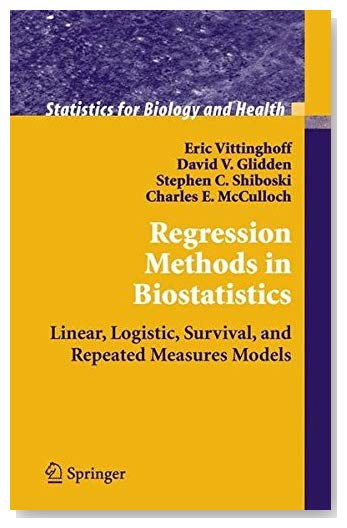
Home > Books > Regression Methods in Biostatistics: Linear, Logistic, Survival, and Repeated Measures Models
|
Most Helpful Customer Reviews:
Add Your Own Review |
 Well writing but need updated STATA command, April 13, 2011 Well writing but need updated STATA command, April 13, 2011
By gpatama
|
|
Overall I think this book has friendly written style and nice introduction from real clinical research examples.
Anyway, as a novice clinician, I found it helpful to read foundation concepts from Katz' multivariable analysis before technical operation in this book. Though this book is good in compact and concise but it also trade off with a bit hard to orientated (ie. table and its'explanation locate in different page)
Since this edition revised before 2009 (though reprint in 2010), it seem some of STATA commands were out of date for version 11.( eg. xi command for categorical predictors, lfit command for goodness of fit test). The repeated measure part should have more details about categorical outcomes and diagnostic model technique. I am very looking forward to having a new edition of this good biostat book.
Was this review helpful to you?
|
|
|
|
 Regression Methods in Biostatistics: Linear, Logistic, Survival, and Repeated Measures Models, October 17, 2009 Regression Methods in Biostatistics: Linear, Logistic, Survival, and Repeated Measures Models, October 17, 2009
By J. Wong
|
|
Regression Methods in Biostatistics is clearly a very well-organized book, covering topics from simple linear regression theory and methods, to the more complex survival analyses. The material is especially recommended for students who have just completed introductory biostatistics and statistical programming, and are looking for practical applications of their skills (of course, for those looking for more thorough practice, it is recommended that those individuals take more advanced biostatistics courses). Relevant examples are abundant throughout the chapters, and the authors are also very thoughtful in providing a website ([...]) where one is able to download the data (in all types of files) used in all the examples in the book, as well as for the practice problems. One drawback to this book, however, is the authors' reliance on only STATA to present the modeling examples; this is incredibly useful for primarily STATA users (the authors provide tips on STATA codes) but not particularly helpful for SAS users, for example (though it is certainly not a very huge learning barrier).
6 of 6 people found the above review helpful.
Was this review helpful to you?
|
|
|
|
 Great resource, June 05, 2008 Great resource, June 05, 2008
By D. Collingridge
|
|
I have owned this book for a couple of weeks. In that short time it has proven very useful to me.
The authors use an easy-to-follow writing style and don't get too bogged down in theoretical, statistical formulas. It is full of useful figures that illustrate the points being made. Note: although the authors rely on Stata for creating their printouts and figures, this is not a book on how to use Stata. You don't get the feeling that you have to learn Stata in order to follow along. I have found that most of the Stata diagrams are very similar to the diagrams created in SPSS, and probably SAS and R for that matter.
Although I am reading the book from beginning to end, I have already gleaned some useful information from advanced chapters, thus suggesting that it is a good reference book. For instance, I was frustrated by the lack of coverage on interpreting log transformed data (in multiple regression) in other stats books. I was pleased to discover that this book covers this issue in a clear and concise manner. I am also pleased that the authors have included a chapter on generalized linear models.
This is a very good book for people working in health care research. The authors talk to the reader and explain things in a lucid manner (I have read several stats books that do not do this, so it is a refreshing change). The authors also provide many practical examples to clarify the issues. A background in the basics of statistics is required.
3 of 3 people found the above review helpful.
Was this review helpful to you?
|
|
|
|
Excellent book, April 21, 2008
By I. RIGAS
|
|
That is exactly what the title promises. High yield introduction to clinically applied regression methods. A marvel of a book for the subject.
Was this review helpful to you?
|
|
|
|
Nice coverage of important topics for biostatisticians, November 29, 2007
By Michael R. Chernick
|
|
The authors say that they created this book to fit with a course they taught at UC San Francisco to medical students. The book is very sophisticated and a great reference source for practicing biostatisticians in industry or research. It surprises me a little that they find it effective for there non-technical audience. Although the topics are technical and many are advanced they do cover it in a conceptual way without heavy mathematics but still requiring some statistics classes as prerequisite.
Regression does not cover all the techniques of biostatistics but as the authors point out the four topics in the subtitle are among the most important. I know this from my many years of experience as a bisostatistician in the medical device and pharmaceutical industries. They use many good practical examples useing many of the common variables studies in many clinical trials where physical exams are given to record blood pressure and other vital signs and chemistry labs are done to determine cholesterol levels and other things that can be factors in various diseases. Also glucose levels are very important to monitor for diabetes trials.
In addition to the standard topics general estimating equations and generalized linear models are covered and where appropriate bootstrap confidence intervals. There is even a chapter on complex surveys a topic important when quality of life is an endpoint and survey instruments are used to measure it.
In the survival analysis chapter the Kaplan-Meier curves, log rank tests and Cox proportional hazards models are covered as expected but the authors go further to include extensions of the Cox model when the proportional hazards assumption fails. My only disappointment is that there is no coverage of actuarial life tables. At the medical device companies that I worked for it was common to get interval data on events rather than continuous data and then the Cutler-Ederer life table method is the analog for interval data to the Kaplan-Meier estimator for continuous data.
The book covers many topics but is concise as the authors claim. The authors provide a lot of examples that they work out using the statistical package Stata. The authors claim that Stata is the package of choice for biostatistics. This may be the case in academic settings but is certainly not the case in the pharmaceutical industry where SAS is used almost exclusively. I think that it would have been better to show how to write the computer code for solving these problems both in SAS and Stata. To the authors credit Stat is a very good package for their purpose and they do at times mention SAS and SPSS which are the other two major statistical packages used in industry.
All in all this is a very good book that is worth its list price. I will use it as a reference. it also contains a very nice bibliography of 9 pages.
37 of 37 people found the above review helpful.
Was this review helpful to you?
|
|
|
|
very good book, compact but comprehensive, May 11, 2007
By Student_PhD
|
|
This book covers a wide range of topics in Biostatistics, in a comprehensive, but not overwhelming way. In my opinion this book has the potential of being useful to a broad audience, from Statisticians to other professionals who do health related research.
5 of 5 people found the above review helpful.
Was this review helpful to you?
|
|
|
|
See all 7 Reviews.
|
|
|
|


 (
(