|
|
|
|
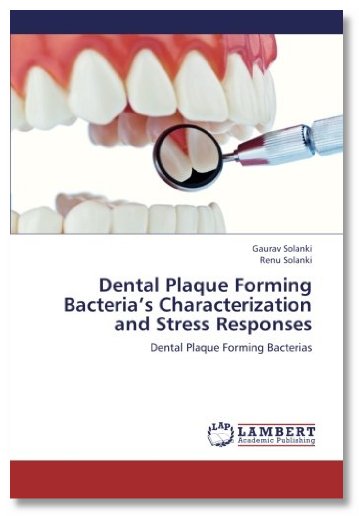
Dental Plaque Forming Bacteria's Characterization and Stress Responses
|
|
By Gaurav Solanki BDS and Renu Solanki BDS
|
|
List Price: $75.00
|
|
Our Price: $73.13
|
|
You Save: $1.87 (2%)
|
|
|
Availability:
|
Available for immediate delivery.
|
|
Publisher:
|
Lambert Academic Publishing
|
|
Edition:
|
1st
|
|
Published:
|
November 7, 2012 |
|
Binding:
|
Paperback
|

|
|
|
| |
| Product Description: |
|
| |
|
Dental plaque is a bio-film usually which is of pale yellow color that develops naturally on the teeth. Like any bio-film, dental plaque is formed by colonizing bacteria trying to attach themselves to a smooth surface of a tooth. The most important constituent of bio-film other than bacterial cells is the Extra Cellular Polymeric Slime matrix which is secreted by the bacterial cells themselves. Efforts were made to characterize the EPS matrix by chemical as well as spectroscopic studies. By biochemical identification methods, the bacterial strains isolated were characterized to be S aureus, S salivarius, S mitis, S oralis and Bacillus subtilis. It was also observed that cell attachment was greatest when glucose was used as the sole carbon source. Test for bio-film formation in presence of metal salts showed moderate to high inhibition of film formation. The studies indicate the poor response of two strains towards fructose and sucrose. The EPS characterization results showed that the EPS matrix was made of different bio-molecules such as carbohydrate, protein, lipids and nucleic acids.
|
|
|
| |
|
|
|