Categories
Home
Books
Magazines & Journals
Self-Help
Children's Books
New Releases
Alternative Medicine
Anesthesiology
Basic Sciences
Behavioral Science
Board Review Preparation
Caries and Cariology
Cosmetic Dentistry
Dental Anatomy
Dental Anthropology
Dental Assisting
Dental Hygiene
Dental Materials
Dental Morphology
Dental Nursing
Dental School Application
Dental Technology
Economic Reports
Emergencies
Endodontics
Forensic Dentistry
Geriatric Dentistry
Gnathology and Occlusion
History
Implantology
Laser Dentistry
Nutrition
Operative Dentistry
Oral Medicine
Oral Pathology
Oral Radiology
Oral Surgery
Orofacial Pain
Orthodontics
Pediatric Dentistry
Periodontics
Cosmetic Periodontics
Perio Surgery
Pharmacology
Practice Management
Preventive Dentistry
Prosthodontics
Public Health
Reference
TMJ
Apparel
Dental Artwork
Dental Health Products
Dental Loupes
Dental Office Supplies
Dental Photography
Dental Supplies
Jewelry
Patient Education
Software
Toys, Games and Novelties
Videos
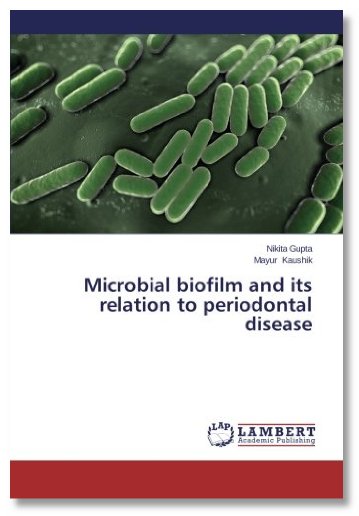
Microbial Biofilm And Its Relation To Periodontal Disease
By Nikita Gupta BDS and Mayur Kaushik BDS MDS
$63.00
Availability:  Available for immediate delivery.
Publisher:  Lambert Academic Publishing
Edition:  1st
Published:  January 5, 2015
Binding:  Paperback
check price
 
Product Description:
 
Periodontal diseases are infections caused by micro-organisms that colonize the tooth surface at or below the gingival margin and results from the formation of biofilms on tooth surfaces and are of immediate concern. Dental biofilms are defined as a diverse community of microorganisms living as a structural unit,with complex communication pathways between species. The presence of a oral biofilm alone is often not sufficient to cause disease because most oral biofilm-associated diseases are complex with a multifactorial etiology. Advances in molecular techniques have given rise to a much greater understanding of the diversity and complexity of human micro-biota communities,including dental plaque. Plaque development may no longer be thought of in generic terms,but rather,as a highly individualized process. With that come new avenues for the understanding of plaque development in relation to its host,and therefore the potential for the development of more effective treatments.
 
Be the first to add a review
Copyright © 2026 dentalBookshop.com. All rights reserved.