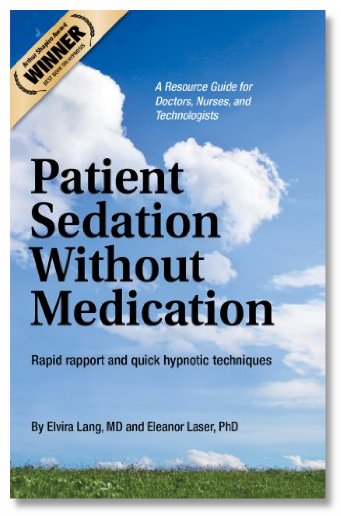
|
|
|
Most Helpful Customer Reviews:
Add Your Own Review |
 it was a good review of techniques with clinical anecdotes and explanations of ..., May 30, 2015 it was a good review of techniques with clinical anecdotes and explanations of ..., May 30, 2015
By Becky
|
|
Well written, focused, specific, and instructive. Comes with a few scripts to use or try in different situations. As a hypnotist, it was a good review of techniques with clinical anecdotes and explanations of how they fit some situations better than others.
Was this review helpful to you?
|
|
|
|
Battle-tested, September 22, 2013
By Ken Kardash (Montreal, Canada)
|
|
As an anesthesiologist I was interested in possibly applying hypnosis as an adjunct for pain relief and sedation in patients undergoing surgery. This book appealed to me because of its practicality. It is short, concise and results-oriented. The fact that Dr. Lang developed and refined her approach in the setting of interventional radiology attracted my interest because the time and pressure stakes are comparable to the operating room. Other books on hypnosis I'd seen involved psychotherapy or personal improvement applications, where the subject is already motivated and usually in a more relaxed setting. In fact, I'd assumed that the technique could only work if undertaken under calm conditions in advance. But the approach used here is applied in real time, as the patient is undergoing the actual procedure. That and the fact that the authors offer it to all patients, not just a select sub-group, convinced me that the technique must be effective.
The writing and organization of the book further reassured me that this is a no-nonsense, systematic approach whose results can be objectively measured. Each chapter starts with a short case report that not only illustrates a point, but also the clinical details of which convinced me that the authors have extensive real-life experience dealing with anxious patients! The chapters are bite-sized and clear, consistently evidence-based and referenced, and end with a bullet list summary of key points. In fact, it could be fairly described as a manual for procedural hypnosis, including scripts for induction that can be used verbatim. Of course, as I'm sure the authors would agree, some supplemental training would be highly desirable.
I congratulate the authors on their refreshing pragmatism and offer my five stars.
1 of 1 people found the above review helpful.
Was this review helpful to you?
|
|
|
|
This totally changed my view about hypnosis., July 14, 2013
By Paul
|
|
This totally changed my view about hypnosis. Previously my idea of it was probably similar to a lot of people’s: and would involve images of a magician on stage getting somebody to do something silly for the entertainment of others. Or, one of my friends would go off to be hypnotized by a mysterious character to stop smoking.
But it turns out that medical staff are using hypnotic techniques to provide real benefit to patients undergoing procedures where sedation is either not desirable or not an option.
An example would be an MRI, where a patient has to stay still for a very long time. I’ve never had an MRI, but had previously thought it might be rather soothing. But what I didn’t realize is how long you have to be in there for, and that it is quite noisy.
The way it’s explained is that under hypnosis you enter a state a lot like day-dreaming, or “spacing-out” – which I certainly can relate to. Wouldn’t it be great to “space-out” during a long procedure you’re not looking forward to? Medical Hypnosis does just that.
In an NIH funded study, patients were offered the option of a “relaxation exercise” before under going the procedure. To keep things consistent, all the healthcare providers used the same standard script devised by a Stanford Psychiatry Professor.
The book contains that script.
As a non-medical person, and a squirmy patient I found it fascinating.
The book tangentially gave me an a-ha moment concerning people who don’t make eye contact. I’d always thought they were being rude, but in fact it is just their particular way of listening intently, dictated by their sensory style (sight, sound, touch etc.)
The other a-ha moment concerns building rapport between doctor and patient. And how things small things might affect it.
I have experienced this first hand in my doctor’s consulting room.
He is a wonderful doctor, but the layout of the room places him very far away from me; and we are separated by a computer. It all conspires to make me feel rather isolated, and is not an ideal layout for our rapport to flourish.
2 of 2 people found the above review helpful.
Was this review helpful to you?
|
|
|
|
Great Book, January 11, 2012
By Oxcart
|
|
This is a great book. I recommend it for teaching to be used as a textbook for learning hypnosis/guided imagery in clinical settings. It reinforces that this isn't neurosurgery and can even be done by use of a script. Great examples and helpful hints to move you along.
You will find this a great addition to your library.
1 of 1 people found the above review helpful.
Was this review helpful to you?
|
|
|
|
|
|
|