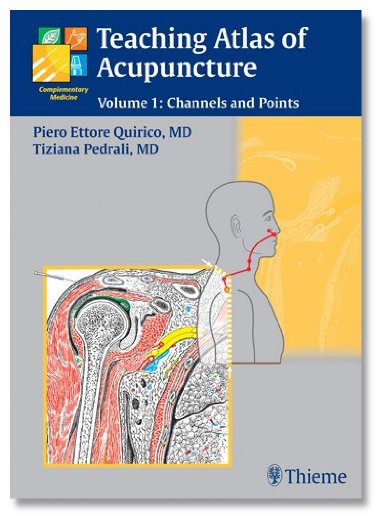
This is the atlas for which I have been waiting, actually craving. Its unfortunately a bit pricey. Might want to consider the discounted two volume set directly from the publisher. Though for Volume 1 alone the price was similar to here.
Excellent color drawings of anatomy for acupoints. Extremly well organized with respect to channels. Includes good cross-sectional drawings of the tissue so that one sees not only where a needle enters the skin, but where it lies in the subcutaneous and deeper realms with respect to bone, blood vessels, nerves, etc. Although they are not photos from cadavers, they are meticulously well done and quality exceeds that of computer-simulated attempts such as in QPuncture II.
PROS
1. Well organized!!! Section One begins with an overview of the 12 regular channels with substantially more comprehensive detail than most point atlases. This includes the origin of the channel within the internal organs, the collaterals, and crossing points if relevant. As an example: for the HAND GREAT YIN (Lung)CHANNEL it goes well beyond simply showing shoulder to thumbtip (Lu-1 to Lu-11). It also describes the deeper course, its overall function and then illustrates the origin of the lung channel in the middle jiao, its descension to the large intestine, its returns upward across the upper orfice of the stomach, its passage through the diaphragm to enter the lungs, the throat, the anterior shoulder and finally its traversal from Lu-1 through Lu-11. A collateral from Lu-7 to LI-1 is also explained and illustrated. This overview is followed by a well-designed table that includes the following key information about each point in the lung channel as shown below. This basic format is repeated for all 12 of the regular channels. A similar organization is adapted for the 8 extraordinary channels and extra points of the head/neck, trunk and limbs.
POINT #/NAME, LIST OF ALL FIGURES in the book which illustrate it at various depths;
POINT LOCATION by verbal directions;
METHODS/ANGLES FOR NEEDLING and their respective depth, what De qi typically feels like at this site,
--------Moxa instructions if apppropriate and special notes;
KEY ANATÖMICAL Information -- superficial and deep
CLINICAL INDICATIONS
2. The core treasure!!! Section 2 contains an exquisite set of anatomical drawings depicting vessels, nerves, bones, muscles, subcutaneous fat, etc. Most include a reference diagram which shows how a cross-section image fits into the larger relevant body region. Then needles are drawn over the cross-section in such a manner than one sees how it should travel through or near by critical regions depending on insertion depth. These are provided in truly excellent detail.
3. Some briefer bonus material. Section 3 is interesting but pretty succinct. It presents a very quick overview of: the 6 "Great Channels" condensed from the regular 12; the more external 12 channel sinews (Jing Jin, tendinomuscular meridians); the 6 pairs of divergent channels (distinct meridians); the 15 collateral channels (Luo Mai); and the 12 cutaneous channels of Pi Bu.
4. Finally the appendix includes a few rapid access tables and drawings that serve as reference more than direct teaching materials regarding "relex" or "microsystems": chinese auricular, chinese scalp, the mapping for dermatomes, myotomes, and sclerotomes, the mu/shu points of the trunk, and the viscerocutaneous reflex dermalgias.
Cons
There were only a few disappointments. Most regarded points that for whatever reasons had not been included in a cross-sectional depth drawing. But these omissions were few and far between. I would have appreciated, given the otherwise comprehensive nature of the tables, if they had also included the major classical and modern point attributes such as elemental position, command point position, ghost points, windows of the sky, etc. These latter features are obviously accessible via alternate sources such as Grasping the Wind, QPuncture II and Deadman's Manual of Acupuncture. Yet, I still wish for one or two ultradense acu-sources, should I ever be sent to the perverbial desert island on a distant planet and only allowed to carry a few possessions for my clinic :-)
OVERALL...
This is the most comprehensive atlas I own, satisfyingly rich in meaningful detail. It has greatly increased my confidence in knowing where my needles are travelling. I definitely like having an internal image of what "mysteries" lie below the tiger's whisker, long before I actually encounter them by touch.
8 of 8 people found the above review helpful.
Was this review helpful to you?
|


 (
(