|
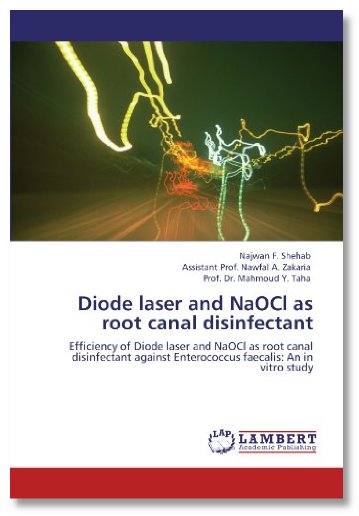
Enterococc faecalis considered to be the most resistant bacteria of the root canal, in the present study we used two types of root canal disinfectant toshow their effect on this type of bacteria, the firstis the diode laser and the second NaOCl solution with special concentrations and times. the study conducted on human decoronated extracted teeth, adjusted with 13mm root length, filled with a suspension of E. faecalis, Samples were divided into 14 groups each group consisted of 10 prepared roots, sixty samples were irrigated with NaOCl solution at different concentrations (0.5%, 2.5% and 5.25%) at twoselected times (2 minutes and 5 minutes) for each concentration. Sixty samples were irradiated at different powers (2W, 2.5W and 3W); each power at the total irradiation time 30 and 60 seconds. When comparison was made between NaOCl irrigant and diode laser in a combination among different concentrations, powers and times the result showed that 5.25% NaOCl at both 2 minutes and 5 minutes had the highest antimicrobial effect with no significant differences from 3W laser / 10 sec (6 cycles) but significantly different from 3W / 5 sec (6 cycles). Author Information Najwan F. Shehab is assistant lecturer for the Department of Conservative Dentistry at Najwan F. Shehab College of Dentistry, University of Mosul, Iraq. Nawfal A. Zakaria BDS, MSc is Assistant Professor in the Department of Conservative Dentistry at College of Dentistry, University of Mosul. Mahmoud Y. Taha BVMS, MSc, PhD is a Professor of Microbiology, Department of Dental Basic Science, College of Dentistry, University of Mosul and Member of Editorial Board of Al-Rafidain Dental Journal. Dr. Taha eaned his BVMS in 1979, his MSc in virology in 1982, his PhD in molecular virology in 1990 and his Dc.path in 2000.
|