|
|
|
Most Helpful Customer Reviews:
Add Your Own Review |
 Hypnosis theory, August 01, 2014 Hypnosis theory, August 01, 2014
By Susan Moulton (Mobile, AL USA)
|
|
Interesting, but not quite what I had expected. I was looking for some alternative ideas for my hypnosis sessions, this is more theory.
Was this review helpful to you?
|
|
|
|
 The handbook of Hypnotic Phenomena in Psychology, July 05, 2013 The handbook of Hypnotic Phenomena in Psychology, July 05, 2013
By Willie Engelbrecht
|
|
This is a must have for all Psychotherapists. It is loaded with information and is concise. The phenomena can be used in or out of trance work. Easy to read. One should be well founded in trance work to get to the essence of the information.
Was this review helpful to you?
|
|
|
|
Excellent, January 15, 1999
By A customer
|
|
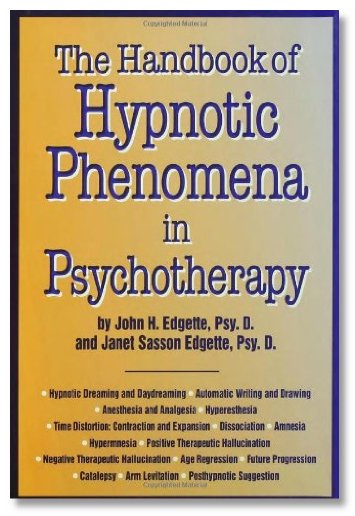
A review as appeared in the International Journal of Clinical and Experimental Hypnosis,July 1997,Volume XLV, Number 3. The Handbook of Hypnotic Phenomena in Psychotherapy presents a discussion and an exploration of the use of the hypnotic phenomena that are the natural outgrowth of trance. The authors describe in detail the different hypnotic phenomena and how they can be used therapeutically for clinical interventions. The hypnotic phenomena discussed in this book include amnesia, hypermnesia, posthypnotic suggestion, time distortion, age regression, future progression, dissociation, hypnotic dreaming, catalepsy, arm levitation and ideomotor signaling, automatic writing, anesthesia and analgesia, hyperesthesia, and positive and negative hallucinations. The Edgettes present their material from a theoretical orientation that is largely based on an Ericksonian approach. Nevertheless, their presentation of the potential clinical applicaitons of the various hypnotic phenomena, as demonstrated by a number of clinical case examples, would be of general relevance to clinicians from a wide range of theoretical orientations. The authors' stated goal in this book is to take the practitioner of hypnosis beyond the use of hypnotic phenomena as an indicator of successful clinical induction or as a measurement of hypnotic induction and depth in laboratory experiments. Instead, they explore and explain how these hypnotic phenomena can be used as a vehicle for clinical intervention. In my opiniion, the Edgettes have been highly successful in achieving their goal. They have written an extremely clear and readable explanation of the potential for using hypnotic phenomena in clinical interventions. There is a chapter devoted to each of the hypnotic phenomena. Each chapter is then organized into clear and consistent subdivisions covering such topics as experimental studies, indications for use, contradications, techniques of eliciting the phenomenon, and selected case examples and transcript material. As a clinician working in the field of psychotherapy and using hypnosis in my practice, I found the chapters discussing the specific phenomena and their clinical applications to be of most interest. In contrast, I found the introductory chapters to be less interesting and useful. However, a research-oriented reader or clinician with a different backgraound might well feel differently. In regard to the chapters dealing with the different hypnotic phenomena, some wonderful excerpts are provided of verbalizations that could be used in specific clinical situations. An example of such excerpts is the authors' description of the use of the hypnotic phenomenon of amnesia to help a client "forget to remember about that old habit" of smoking (p.51). The chapter on the phenomenon of age regression was of special interest to me as a clinician because of my own work in this field: particularly in the use of age regression with "creative self-mothering" and the creation of "healing scripts" for clients with severely abusive or deprived backgrounds. In discussing their work in this area, the authors appropriately note that clients working with these issues may require special care and expertise on the part of the therapist due to the clients' impairment and vulnerability. However, the authors also support the use of age regression as a tool for creating positive images and feelings in such severely deprived clients. They suggest that hypnosis can purposefully and therapeutically augment the client's personal history. In summary, I feel that The Handbook of Hypnotic Phenomena in Psychotherapy is an excellent book. It provides a new perspective on the importance of hypnotic phenomena, and it also opens the way for potentially new and expanding uses of these phenomena in the clinical setting as vehicles of therapeutic intervention. Review by: Joan Murray-Jobsis Chapel Hill, North Carolina
18 of 18 people found the above review helpful.
Was this review helpful to you?
|
|
|
|
|
|
|


 (
(