|
|
|
| Product Description: |
|
| |
|
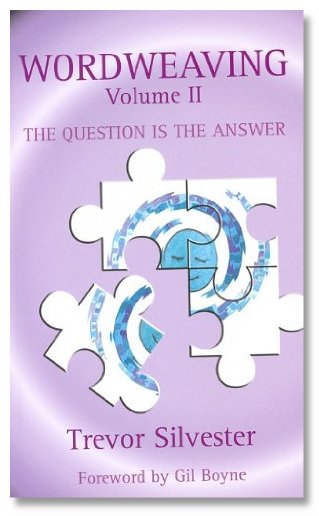
Modern hypnotherapy involves far more than reading problem-related scripts to clients. It involves understanding the client and using their way of seeing the world to help them with their issues. In Wordweaving, Volume II: The Question is the Answer, Trevor Silvester shows you how to ask the questions that provide you with the information you need to create hypnotic language patterns specifically for each client, and guide them to finding their own answers to life's problems. Building on the model introduced in Wordweaving, Volume I: The Science of Suggestion, this volume will help you integrate your suggestions into a model of therapy that guides you from the first appointment to the last, maintaining your focus on the client's outcome, and adapting to the changing situation as it evolves. Using a questioning model developed by Gil Boyne, the author shows you how three simple questions can uncover the pattern of a client s issue, and also create their evidence for recovery. How we imagine our future is a key to how we create it. This book also shows you how to guide the client to their most fulfilling future and provides a script based on scientific research that has been proven to increase how lucky we feel. Volume II: The Question is the Answer is aimed at therapists and counselors who want to improve their ability to ethically influence, develop amazing hypnotic language skills, and have a therapeutic framework that provides the maximum opportunity for creativity, without sacrificing clarity of purpose.
|
|
|
| |
Most Helpful Customer Reviews:
Add Your Own Review |
 Magical words meet science., November 27, 2014 Magical words meet science., November 27, 2014
By Rich Peacock
|
|
I was taught cognitive hypnotherapy many years ago by Rebecca & Trevor Silvestor. They opened my eyes, ears, mind and heart to a better way. Word weaving is a magical language of transformation and every therapist should read all about it.
Was this review helpful to you?
|
|
|
|
Excellent Innovative Book, January 18, 2012
By Rubin Battino
|
|
This is a well-researched book that combines hypnosis and NLP (Neurolinguistic Programming) and the author's analysis of how people get stuck and how to help them go beyond that to less troubled lives. Cognitive Hypnotherapy provides a framework for both understanding ourselves and our lives and many ways for therapists to tailor treatments to their clients. It is theoretical and pragmatic. Part One is about the science of ourselves, and Part Two gives the philosophy and practice of cognitive therapy.
Silvester suggests (p. 4) "... that what we call memory is just part of a larger system that I call memoragination. It comprises our remembered past, our perceived present, and our anticipated future." He goes on to state that this is necessarily plastic, is being continuously updated, and that changing it can lead to new behaviours. Since memory is malleable it can be changed so that the "memories" which control our lives can be effectively reframed to lead to more satisfactory lives.
Two critical observations provide the basis for this. The first was Ernest Rossi's about the fact that you cannot access a memory without changing it because your present perspective influences the emotional coloring of the event in your mind. The second is Joseph LeDoux's discovery that every time you recall a memory it renders it "unstable" in the sense that it can be changed. This means that the mood you're in when you remember something can affect the way you recall it next time.
Silvester emphasizes the power of AS-IF, that is, the world that we live in becomes the one we anticipate, and we thus become the kind of person who lives in such a world. This is the essence of the effectiveness of the power to change clients via the use of the Miracle Question. Silvester summarizes this as (p. 35), "We create the future we anticipate, so be mindful of your language." Hypnosis is a major player in these changes, and the author rightly suggests that any time you are working with memories that the client is in a trance state.
The goal of therapy is to go from problem to solution. One way of doing this is via Time-Line Therapy, and the author gives details as to how this may be done. (Incidentally, David Cheek's used ideomotor signalling as a way of effectively doing this.) Silvester's use of language to bring about change in these ways is precise and elegant, and is some of the most careful I have ever read.
In Part 2.5 six methods are presented in pragmatic detail for effecting change via the use of submodalities. These can be considered to be the basic units of thoughts as in the variants in which we see (visual), feel (kinesthetic), and hear (auditory). The six methods are: headache cure, swish pattern, spinning, dropthrough, visual squash, and rewind. There is not sufficient space in this review to adequately discuss these methods-suffice it to state that they need to be studied, and should be in the toolkit of every therapist.
Silvester's analysis of how people get to be who they are and how you can be an effective change agent in their lives is brilliant, and studying this book will change the way that you work.
Was this review helpful to you?
|
|
|
|
Useful for Coaches and Therapists, December 04, 2011
By hypnotherapist (Canada)
|
|
This book is a part of the trilogy of books the author has named Cognitive Hypnotherapy, and you will get the most of them if you go through all three - Wordweaving, The Question is the Answer (previously called Wordweaving 2), and Cognitive Hypnotherapy: What's That About.
The Question is the Answer continues where the first book, Wordweaving, volume 1 left off.
While the first book, Wordweaving, is focused on explaining the elements used in the Wordweaving / Cognitive Hypnotherapy process, the second book is focused on putting together all those elements and applying them to problems states for the purpose of priming the client's mind with the evidence of the solution states.
Was this review helpful to you?
|
|
|
|
|
|
|