|
|
|
|
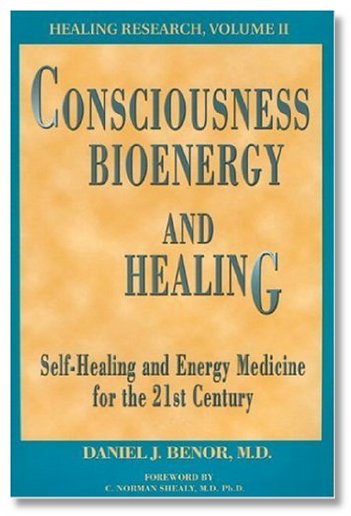
Healing Research Vol II: Consciousness, Bioenergy and Healing: Self-Healing and Energy Medicine for the 21st Century
|
|
By Dr Daniel J Benor
|
 (4 Reviews) (4 Reviews)
|
|
|
| |
Most Helpful Customer Reviews:
Add Your Own Review |
 A Valuable Overview of Energetic Healing, September 20, 2007 A Valuable Overview of Energetic Healing, September 20, 2007
By Charles I. Campbell (Tappan, NY United States)
|
|
Dr.Benoir has provided an amazingly comprehensive review of research relating to energetic healing with special reference to self-healing. In spite of its breadth, the book manages to treat in 700 pages a vast array of data in satisfying depth. With over 200 pages of notes, references, a glossary and indexes of names and subjects, Dr.Benoir has made his own material readily accessible, but also a starting point for the reader's further in-depth study. This is the second of a four-volume series, the first addressing the scientific validation of spiritual or energetic healing, the third on out-of-body and near-death experiences and evidence for existence of the soul after death as well as insights provided by quantum theory, and the fourth, which synthesizes the matgerial in the preceding three volumes. Highly recommended!
2 of 2 people found the above review helpful.
Was this review helpful to you?
|
|
|
|
Consciousness, Bioenergy and Healing, February 14, 2007
By Jennifer Bassett (Connecticut)
|
|
In the ever pondered question "how does healing happen?", Daniel J. Benor discusses the role of consciousness in spiritual healing. In his second book of four on healing research, entitled, Consciousness Bioenergy and Healing, Dr. Benor discusses the current research and theories associated with how biological energy therapies might contribute to healing. He systematically reviews dozens of types of complementary therapies that have some aspect of spiritual healing associated with them to investigate the relationships between the complex workings of consciousness, and how people seem to be able to tap into it to heal others or themselves. It is important to understand that he defines spiritual healing as "a systematic, purposeful intervention by one or more persons aiming to help another living being by means of focused intention, hand contact, or passes to improve their condition." These therapies include but are not limited to therapeutic touch, biofeedback, reiki, healing touch, prayer, meditation, and qigong.
One of the most interesting aspects of this book is the question of how much healing is associated with the collective consciousness. We have no true understanding about how our thoughts affect each other for good or ill. Is it possible that we are able to tap into the Universal All to heal others and ourselves, or is it simply by suggestion that some kind of placebo effect is generated? Can suggestion activate our internal healing abilities that go beyond placebo to true healing? Dr. Benor believes that much of the research we have leans towards a universal connectedness both biologically and cosmically that we have hardly begun to understand.
Another large area of discussion is the relationship of spiritual healing in Psychotherapy. Many Psychotherapists are now incorporating aspects of spiritual healing into their practice. This area is of great interest to Dr. Benor as he is also a Psychotherapist. An aspect of spiritual healing that can be of great distress among healees, is that very often some profound realization may be brought to the surface that then leaves that person without professional support to deal with the consequences of that realization for continued healing. On the other side, when individuals are cared for under psychiatry assistance, drugs are often used to curtail anxiety that may better suited to the type of care, concern and suggestion by spiritual healers that you are not alone and will be healed. Suggestion in all forms can alleviate meta-anxiety.
When a reciprocal relationship is created between healer and healee spontaneous insights and understanding develop. Dr. Benor believes that there are several mechanisms that may contribute to these effects that alleviate, what he calls, meta-anxiety. Meta-anxiety is a type of anxiety that occurs when worrying about the possible outcomes of things like disease. If Psychotherapists can incorporate some of this type of relationship seen between healers and healees, it is possible to treat someone without the incorporation of drugs with this type of anxiety. Some of the key factors in this relationship are that 1.) Healers and healees trust that whatever happens during healing is directed by a higher power, 2.) Healers and healees communicate on a very deep levels during healing (telepathic or clairvoyant) and 3.) The healing process itself appears to help healees deal more effectively with their primary-level emotions, thus eliminating the meta-anxiety and panic.
Very little is understood about how energy therapies work to heal the body. There is much to be researched and understood. As we look deeper into this area, it is important to realize the intricacies of healing. There is no one road towards wellness, and all these roads seem to be intertwined into a complex web that will make it difficult if not impossible to qualitatively study without major flaws in research and its design. While it may be possible to study some of the competencies that create a successful healing, we may never fully understand in a scientifically designed manor the right combination of science and spirituality to cure what allies us.
8 of 8 people found the above review helpful.
Was this review helpful to you?
|
|
|
|
 Human Consciousness and Healing, January 01, 2007 Human Consciousness and Healing, January 01, 2007
By M. A. Cooperstein (Willow Grove, PA United States)
|
|
As a clinical psychologist, I am always amazed when, after asking Christian patients if they believe in spiritual healing, they say yes, adding that only holy figures are capable of this gift and not themselves.
They are unaware that "miraculous" healings have been reported since the biblical era, but the origins date back to shamanic, magico-religious healing traditions extending as far back as 15,000-40,000 years, during the Paleolithic era or that experimental studies have taken place since Bernard Grad's seminal work in the 1960s.
In contemporary Western societies, culturally unorthodox, non-instrumental physical healing procedures are known by many names: Christian Science healing, faith healing, laying-on of hands, mental healing, prayer healing, psychic healing, spirit healing, spiritual healing, etc.
Periodically, unorthodox healing methods reach public attention through the unscrupulous acts of self-proclaimed healers as well as their debunkers, whose sensational tactics rival those they seek to discredit While more vocal and negatively-biased skeptics continue to unmask ever-present charlatans in their attempts to confirm that these alleged phenomena have no place in society, serious investigations of alternate healing methods by dedicated, credible researchers have received little public or scientific attention or funding.
The growing interest in alternate healing practices is the focus of a sociological study. McGuire and her associate examined the use of alternative healing systems among "middle-class, middle-aged, well-educated, socially, culturally and residentially established suburbanites". Although adherents continued to use conventional health care in addition to an alternative healing system, they were attracted to the latter's holistic belief systems and were not driven by medical crises, as had been assumed earlier. These movements offer transcendent, holistic cosmologies, integrating the individual, the world, and the universe through the incorporation of symbols of transcendent power and order. This suggests that there is more than physical healing being sought in such practices, something that lies beyond that "dreamt of in [our] philosophy."
Consequently, the attractiveness of alternative healing practices cannot be fully explained by positing a loss of faith in conventional medicine or a need to ameliorate intractable physical disorders where conventional medicine has failed. Beyond these possibilities, the growing popularity of alternative healing practices suggests that they may address a deeper, broader, and more archaic human need in the healee and the healer.
In his remarkable accomplishment developed over two decades, psychiatrist Daniel Benor has compiled the most comprehensive collation and annotated analyses of anecdotal, clinical and experimental studies into these types of healing. Having known Dan for over 20 years, I am impressed with his persistence and objectivity in gathering information, his insights into research methodologies while remaining in touch with his humanity.
His 4 volumes are an act of love and legacy of good science dedicated towards a poorly understood, yet intensely interesting and another important aspect of the science of healing, core human needs and consciousness. I am honored to have been included in the first volume of this outstanding achievement.
8 of 8 people found the above review helpful.
Was this review helpful to you?
|
|
|
|
The Scientific Evidence for a Revolution in Healthcare, March 12, 2006
By Dr. Richard G. Petty (Atlanta)
|
|
We owe Daniel Benor an enormous debt of gratitude for taking the time (over 25 years and counting (!)), effort and energy to see if there was any research evidence to support the use of "Energy Medicine" and Healing, and then to carefully analyze what he found.
Many years ago Dan told me that the evidence for spiritual healing was better than that for most of the rest of complementary medicine, and considerably better than the evidence for some widely used methods and techniques in use in conventional medicine!
Here is the evidence for that statement. This is the second of four volumes that will ultimately constitute part of Dr. Benor's legacy to a grateful world.
For people needing less of the research background, there is also a version of the same book for a more general readership - How Can I Heal What Hurts? (Healing Research, Vol. 2; Popular Edition) - that is also available at Amazon, that I recommend as highly as this volume.
21 of 21 people found the above review helpful.
Was this review helpful to you?
|
|
|
|
|
|
|