|
|
|
| Product Description: |
|
| |
|
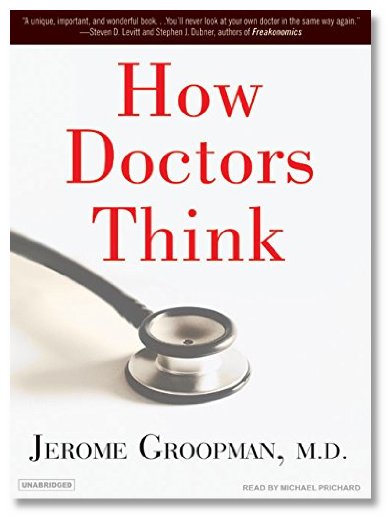
On average, a physician will interrupt a patient describing her symptoms within eighteen seconds. In that short time, many doctors decide on the likely diagnosis and best treatment. Often, decisions made this way are correct, but at crucial moments they can also be wrong -- with catastrophic consequences. In this myth-shattering book, Jerome Groopman pinpoints the forces and thought processes behind the decisions doctors make. Groopman explores why doctors err and shows when and how they can -- with our help -- avoid snap judgments, embrace uncertainty, communicate effectively, and deploy other skills that can profoundly impact our health. This book is the first to describe in detail the warning signs of erroneous medical thinking and reveal how new technologies may actually hinder accurate diagnoses. How Doctors Think offers direct, intelligent questions patients can ask their doctors to help them get back on track. Groopman draws on a wealth of research, extensive interviews with some of the country's best doctors, and his own experiences as a doctor and as a patient. He has learned many of the lessons in this book the hard way, from his own mistakes and from errors his doctors made in treating his own debilitating medical problems. How Doctors Think reveals a profound new view of twenty-first-century medical practice, giving doctors and patients the vital information they need to make better judgments together.
|
|
|
| |
Most Helpful Customer Reviews:
Add Your Own Review |
 Five Stars, July 25, 2016 Five Stars, July 25, 2016
By Laura Trusila
|
|
Great read
Was this review helpful to you?
|
|
|
|
Compulsory Reading For Those Seeking To Understands The Mind Of Doctors, July 19, 2016
By ZyPhReX
|
|
There are doctors that follow the tune that the Medical Industrial Complex plays, and there are ones who buck the trend. Dr. Groopman is one of the latter, thankfully.
In How Doctors Think, The New Yorker staff writer and Harvard professor of medicine & researcher Dr. Groopman offers a distinctive look into the structure of Big Medica in search for what exactly is the type of mindset Doctors employ when practicing their jobs.
Groopman does a compelling job throughout the book in making sure he relates the plights plaguing medicine from both sides of the coin, from the patients perspective, as well as from the perspective of a physician. This aids in the book not being one sided. It helps greatly that he’s also a Doctor with experience in this very field.
From medical, money, marketing, uncertainty, dogma, to various other components of medicine, Groopman attempts to turn over as many stones as possible in his search for what issues are the ones plaguing Doctors the most.
A notable point in the book that hit close to home, which many people will relate to is the emotional tension that can arise at times between patients and their doctors. Essentially, whether patients and doctors like each other. Groopman relates what Social Psychologist, Judy Hall discovered regarding emotional tension:
“..that those feelings are hardly secret on either side of the table. In studies of primary care physicians and surgeons, patients knew remarkably accurately how the doctor actually felt about them. Much of this, of course, comes from nonverbal behavior: the physician’s facial expressions, how he is seated, whether his gestures are warm and welcoming or formal and remote. “The doctor is supposed to be emotionally neutral and evenhanded with everybody,” Hall said, “and we know that’s not true.”[1]
What’s worse, is that Hall’s research indicated:
“…that the sickest patients are the least liked by doctors, and that very sick people sense this disaffection. Overall, doctors tend to like healthier people more.”[2] So much for quality health care.
Along with the above example, the author additionally notes many other examples of issues that arise due to a crisis in communication which can arrive in myriad ways.
In fact, one of these issues that Groopman relates is that:
“…on average, physicians interrupt patients within eighteen seconds of when they begin telling their story.”[3]
Another salient aspect of Big Medica that the author sunk his teeth into was the psychological aspect of medicine. Predictably, far too often doctors/western medicine view the patients psychological components as being apart from the body, rather than taking a much-needed holistic approach.
Additionally, the institutional dogma that reigns down from the top is also touched upon in a few instances by the author. Open-mindedness is scoffed at, while conformity was expected.
Recounting an example of choosing between the availability of multiple medical options regarding a particular treatment, Groopman relates something noted by physician Jay Katz, who taught at Yale Law school at the time:
“In both [treatments]…we were educated for dogmatic certainty, for adopting one school of thought or the other, and for playing the game according to the venerable, but contradictory, rules that each institution sought to impose on staff, students and patients.”[4]
Another disturbing component that doctors acquiesce to that is covered by Groopman is how doctors far too often give into to corporate interests. This very issue has covered by other doctors such as Dr. Brogan, Dr. Breggin, Dr. Mercola and many others.
This book sheds much needed light into the inner workings of how doctors operate – how they think. While the author notes that a sizeable amount of the issues have a variety of roots at the outset, such as communication, what he conveys still leads to much concern within the Medical Industrial Complex.
In the end, individuals will need to become much more proactive/responsible in their health if they plan to breakaway from the conventional medical system that puts profits over people.
____________________________________________________________________________________
Sources & References:
[1] Dr. Jerome Groopman, M.D., How Doctors Think, pg. 19.
[2] Ibid., pg. 19
[3] Ibid., pg. 17
[4] Ibid., pg. 153
Kindest Regards,
Zy Marquiez
TheBreakAway.wordpress.com
Was this review helpful to you?
|
|
|
|
 The more we know about the challenges and heavy responsibilities that doctors face the better we can discern a path towa, July 17, 2016 The more we know about the challenges and heavy responsibilities that doctors face the better we can discern a path towa, July 17, 2016
By Roger Deutsch
|
|
A well written look at the inner life of doctors. The more we know about the challenges and heavy responsibilities that doctors face the better we can discern a path toward improving the health care system. We rely on doctors. We need to understand the great burdens they carry and by appreciating their perspectives learn how to work with them for our mutual betterment. This book provides a deep look from an insider. It's erudite but not dry. It's highly readable but contains many profound insights illustrated by real life stories.
Was this review helpful to you?
|
|
|
|
The lives of doctors and how they diagnose!, July 16, 2016
By A Customer
|
|
Very interesting!
Was this review helpful to you?
|
|
|
|
 Too sentimental, July 16, 2016 Too sentimental, July 16, 2016
By PeanutButterandJelly
|
|
It starts off well enough, but then gets hopelessly sidetracked into a personal story involving many appeals to God. He doesn't even tell us how his friend came to the conclusion that her baby had a condition different from the doctor's diagnosis. That would have been the one useful bit of information for his readers. Instead we hear all about her anxiety, prayers, singing and calls to her family in California. I decided the rest of the book was probably not worthwhile.
Was this review helpful to you?
|
|
|
|
Good for Medical Students and Others who want to Know HDT, June 25, 2016
By Grandmere T
|
|
Bought 3 copies ....fascinating insights. A doctor told me read chapters 1 and 2 and I'd understand. Read the whole thing and found one of my own favorite docs in Chapter 7!
Was this review helpful to you?
|
|
|
|
See all 353 Reviews.
|
|
|
|


 (
(