|
|
|
|
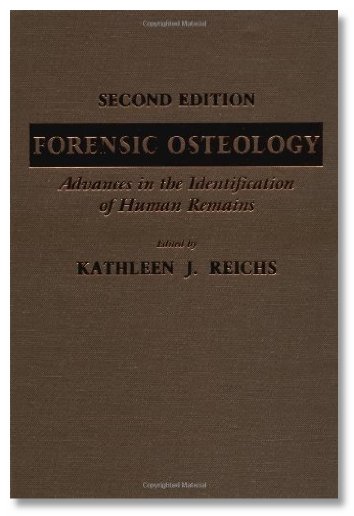
Forensic Osteology: Advances in the Identification of Human, Second Edition
|
 (6 Reviews) (6 Reviews)
|
|
|
Availability:
|
|
|
Published:
|
January 31, 1998 |
|
Binding:
|
Hardcover
|

|
|
|
| |
Most Helpful Customer Reviews:
Add Your Own Review |
 Needs improvement, May 07, 2008 Needs improvement, May 07, 2008
By A. C. Croft (San Diego, CA)
|
|
This textbook has been disappointing in a number of ways. Most importantly, it is very poorly and sparsely illustrated. This is a subject that cries out for photographic imagery and high quality illustration. As an author myself, I realize that illustrations and photographs add a layer of difficulty in manuscript preparation, but without them, you end up with a dry and difficult subject that becomes almost unintelligible. In this book the authors discuss various angles, dimensions, ratios, relationships, and measurements in sometimes vague and ambiguous terms that were nearly meaningless. With illustrations or diagrams, they would have been understandable. Even when we do see illustrations, they often look like amateurish drawings made by authors with limited illustration skills. There are some quality illustrations and photographs, but not enough.
Some of the terminology was simply not explained at all, as though the reader was expected to be already familiar with things like "Carabelli's cusp" or "rocker jaw." Again, not illustrated, and not explained. In other places we are shown a skull of a black individual as illustrating certain identifiable variations allowing forensic experts to differentiate between races. This particular skull appears literally prehistoric. It is missing half its dentition and some of the outer table of the skull. Could the authors not find an a more representative and more intact black person's skull?
Another thing I found particularly annoying, and something that seemed to be common in the various chapters from different authors, is that they frequently referred the reader elsewhere for explanations. Often, these were references to their own work which had been published elsewhere. When I spend more than $100 for a textbook, I expect explication, not showboating. A textbook explains a topic. It is not simply a guide to existing scientific literature.
In the end, a major portion of this material is simply not accessible or easily understandable to persons who are not already quite familiar with this field. As a physician and forensic epidemiologist I am quite familiar with human anatomy. But what is the "suprapubic angle" and how, specifically, is it measured? What about the "vental arc"? These are not common anatomical terms. A simple illustration would have cleared this up nicely.
3 of 5 people found the above review helpful.
Was this review helpful to you?
|
|
|
|
 Good tool, January 27, 2008 Good tool, January 27, 2008
By J. Isaza (Granada, Spain)
|
|
This book is a great tool for those scientists interested in palaeopathology. It is updated and certainly helpful.
1 of 1 people found the above review helpful.
Was this review helpful to you?
|
|
|
|
 Great book, April 03, 2007 Great book, April 03, 2007
By S. Lynch (Las Vegas, NV)
|
|
The books is great! I haven't read through it entirely, but I recommend it to any fledgling forensic scientist. It is an excellent starting point when doing research on dismemberment cases.
1 of 1 people found the above review helpful.
Was this review helpful to you?
|
|
|
|
The latest in Forensic Anthropology, September 23, 2002
By sylvere valentin (Los Angeles, CA USA)
|
|
This book does not contain a full overview of forensic anthropology, as a result it can't be used as an introduction text. However, it deals in depth with certain topics in forensic anthropology, which makes it perfect for advanced students in this field.
10 of 10 people found the above review helpful.
Was this review helpful to you?
|
|
|
|
Cuts Straight To the Bone..., February 27, 2002
By literary sage (Duluth, GA USA)
|
|
This is probably one of the best textbooks available on identifying human remains. I have found it to be fascinating reading plus I recently had the honor to meet Dr. Reichs. She most graciously took the time to autograph my copy of the book although she did mention that was the first time anyone had asked her to do so.
5 of 6 people found the above review helpful.
Was this review helpful to you?
|
|
|
|
An excellent text on forensic anthropology, July 10, 1998
By A customer
|
|
This work covers a wide range of subjects in forensic anthropology, and the contributors are recognized leaders in the field. Recovery of remains, taphonomy and trauma analysis are among the areas discussed. This is a scientific text (although readers of popular fiction will know Kathleen Reichs as the author of "Deja Dead") and background in anatomy, forensic anthropology and related fields will be helpful to the reader.
12 of 14 people found the above review helpful.
Was this review helpful to you?
|
|
|
|
See all 6 Reviews.
|
|
|
|