|
|
|
|
Home > Books > Forensic Dentistry > The Virtopsy Approach: 3D Optical and Radiological Scanning and Reconstruction in Forensic Medicine
|
| Product Description: |
|
| |
|
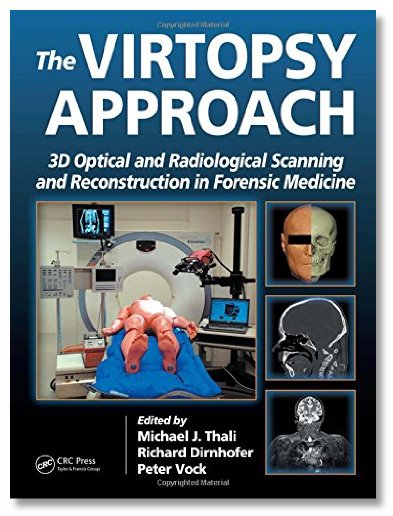
Charred, badly decomposed, or mummified corpses, as well as those restrictions forced upon coroners by certain religious sects, often make autopsies impossible to perform. In addition, lack of manpower among the personnel charged with performing autopsies frequently creates a backlog of cases in the coroner’s office. This delay increases the likelihood that causes of death will go undetermined and criminal perpetrators will go unpunished. The solution can be found in what has come to be known as the virtopsy®, a minimally invasive and efficient way to perform an autopsy through state-of-the-art imaging-guided means. A term coined by noted forensic pathologist Richard Dirnhofer, virtopsy refers to "virtual autopsy," a modality that employs a spectrum of technologies including computed tomography, magnetic resonance imaging and spectroscopy, and 3D photogrammetry and surface scanning. In The Virtopsy Approach: 3D Optical and Radiological Scanning and Reconstruction in Forensic Medicine, the authors reveal a comprehensive summary of the virtopsy procedure. Well-organized, detailed enough to serve as a how-to guide for newcomers to the field, and copiously illustrated with many color figures accompanied by appropriate explanatory captions, this volume breaks new ground in the world of autopsy science.
|
|
|
| |
Most Helpful Customer Reviews:
Add Your Own Review |
 Interesting content but very poor edition for an Imaging book and for the price., November 30, -0001 Interesting content but very poor edition for an Imaging book and for the price., November 30, -0001
By DCOM in Madrid
|
|
The content of this book is great as an introduction to forensic imaging and Virtopsy in particular. However, since there's very few people in the world working in it now, much of the information found here can be read in different papers published during the last 10 years or so. My problems with it have to do with the edition itself. For a U$200 plus book, and especially for a book about imaging, the quality of the paper is unacceptably low, as it is the printing in some parts (text is grayish and/or almost blurred in some pages). The quality of some of the images themselves leaves a bit to be desired as well. There are some mistakes in pictures' descriptions too, although not many. I found the low quality of the edition very disappointing. Something else has to be said: much of the content about CT and MRI in forensic imaging will be found in the corresponding chapter of Brogdon's Forensic Radiology (even images) so if you have that book already, as was my case, and you are interested in the Virtopsy Approach only to get the basics of those two techniques, it may be redundant. Bottomline: it's OK, but could've been and should've been much better. I hope they can come up with a better, true to pricetag edition in the future.
Was this review helpful to you?
|
|
|
|
|
|
|