Categories
Home
Books
Magazines & Journals
Self-Help
Children's Books
New Releases
Alternative Medicine
Anesthesiology
Basic Sciences
Behavioral Science
Board Review Preparation
Caries and Cariology
Cosmetic Dentistry
Dental Anatomy
Dental Anthropology
Dental Assisting
Dental Hygiene
Dental Materials
Dental Morphology
Dental Nursing
Dental School Application
Dental Technology
Economic Reports
Emergencies
Endodontics
Forensic Dentistry
Geriatric Dentistry
Gnathology and Occlusion
History
Implantology
Laser Dentistry
Nutrition
Operative Dentistry
Oral Medicine
Oral Pathology
Oral Radiology
Oral Surgery
Orofacial Pain
Orthodontics
Pediatric Dentistry
Periodontics
Pharmacology
Practice Management
Preventive Dentistry
Prosthodontics
Public Health
Reference
TMJ
Apparel
Dental Artwork
Dental Health Products
Dental Loupes
Dental Office Supplies
Dental Photography
Dental Supplies
Jewelry
Patient Education
Software
Toys, Games and Novelties
Videos
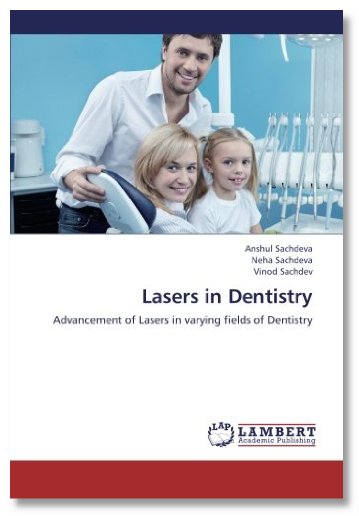
Lasers in Dentistry: Advancement of Lasers in Varying Fields of Dentistry
By Anshul Sachdeva BDS MDS, Neha Sachdeva BDS MDS and Vinod Sachdev BDS MDS
$64.00
Availability:  Available for immediate delivery.
Publisher:  Lambert Academic Publishing
Edition:  1st
Published:  February 27, 2013
Binding:  Paperback
check price
 
Product Description:
 
Technology has allowed the medical field to make many procedures faster and less painful. This applies to dentistry as well. Lasers have become widely accepted in many types of medical practice, and were first used in dentistry in 1994. Lasers work by producing energy in the form of light. It is rather amazing that a tiny beam of light can actually be used as a cutting instrument. It vaporizes the tissue. This light energy also produces heat, which is why it is used to bond fillings and help lighten/whiten teeth. However, if a tooth already has a filling in it, lasers cannot be used. Compared to traditional cutting tools, a laser is extremely sterile?completely germ-free — and actually kills bacteria. Areas worked on by laser typically heal faster than with traditional methods. Lasers can be used in several ways by dental offices. They can remove decay within a tooth or be used to harden/set a filling. Laser dentistry is very precise. It's an effective way to perform certain dental procedures. It requires the dentist's ability to control the power level of the laser as well as the length of time that the laser is exposed to the tissue or tooth.
 
Be the first to add a review
Copyright © 2026 dentalBookshop.com. All rights reserved.