|
|
|
|
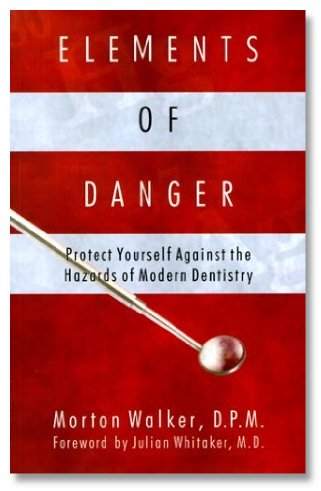
Home > Books > Self-Help > Elements of Danger : Protect Yourself against the Hazards of Modern Dentistry (Paperback)
|
Most Helpful Customer Reviews:
Add Your Own Review |
 Five Stars, October 11, 2014 Five Stars, October 11, 2014
By Boris Shulman
|
|
Useful information for one's health.
Was this review helpful to you?
|
|
|
|
 Helpful, April 29, 2013 Helpful, April 29, 2013
By jaysen
|
|
It is long in getting to thee point as why you need a holistic dentist. But it will give you the needed in encouragement to spend a little extrra for a good dentist.
Was this review helpful to you?
|
|
|
|
 After you read this - visit JSTOR, March 26, 2013 After you read this - visit JSTOR, March 26, 2013
By Pierpont
|
|
If you really want to know the facts, then find peer-reviewed literature. With lines such as "this may suggest that..." and the like, this is far from a scientific resource on these topics.
There are peer-reviewed studies showing that humans are exposed to higher levels of mercury in fish than from amalgam fillings.
Locate a database such as JSTOR. Do the research. Here is one to get you started: [...]
Was this review helpful to you?
|
|
|
|
The Danger in Our Mouths, March 04, 2012
By Jose Miguel Reyes Pulles
|
|
Considered "the most prolific and reliable writer of information about alternative healing methods, holistic medicine, and orthomolecular nutrition of the twentieth century," (Dr. Julian Whitaker, in the Foreword) with seventy-three books published, including fourteen worldwide best-sellers, and the winner of prestigious awards, Dr. Walker assumes in this book the task of exposing the numerous and insidious ways the current standard practices of mainstream dentistry damage our health, contributing to the causes of many of the numerous degenerative diseases and symptoms of "unknown" origin that currently plague humanity.
Dealing with mercury amalgam, root canals, cavitations, and much more, this book is full of facts, concepts and ideas. Hundreds of footnoted references to books and journals, anecdotes, interviews and historical vignettes distinguish his writing, enlightening and enticing the reader into taking charge of one's health.
(This is the review that appears in my article Death is Lurking in Your Mouth (Kindle Edition), which is an overview of amalgam, root canals and cavitations.)
Was this review helpful to you?
|
|
|
|
A must have for every person, June 27, 2009
By smooth
|
|
This is a must have for every person in the world. If that were the case, the health care industry would not be where it is today.
Was this review helpful to you?
|
|
|
|
Fiction only, May 04, 2005
By CONCIA
|
|
Please be warned that this book is not based on research, it is based on opinion and personal stories. The dental community takes patient safety and health very seriously and has conducted extensive research into the subject of dental amalgam. There have been NO well conducted studies to support claims against it. In addition, fluoride is one of the great victories of the public health system, significantly decreasing the incidence of dental caries. Of course ANYTHING in too large of a dose, or taken in an improper manner can be a poison including--yes it is true, even water. "The dose makes the poison" For your health and safety, please don't take this book as fact, as it really has no sound basis!
ADA Statement on Dental Amalgam [...]
Dental amalgam (silver filling) is considered a safe, affordable and durable material that has been used to restore the teeth of more than 100 million Americans. It contains a mixture of metals such as silver, copper and tin, in addition to mercury, which chemically binds these components into a hard, stable and safe substance. Dental amalgam has been studied and reviewed extensively, and has established a record of safety and effectiveness.
Issued in late 1997, the FDI World Dental Federation and the World Health Organization consensus statement on dental amalgam stated, "No controlled studies have been published demonstrating systemic adverse effects from amalgam restorations." The document also states that, aside from rare instances of local side effects of allergic reactions, "the small amount of mercury released from amalgam restorations, especially during placement and removal, has not been shown to cause any ... adverse health effects."
The ADA's Council on Scientific Affairs' 1998 report on its review of the recent scientific literature on amalgam states: "The Council concludes that, based on available scientific information, amalgam continues to be a safe and effective restorative material." The Council's report also states, "There currently appears to be no justification for discontinuing the use of dental amalgam."
In an article published in the February 1999 issue of the Journal of the American Dental Association, researchers report finding "no significant association of Alzheimer's Disease with the number, surface area or history of having dental amalgam restorations" and "no statistically significant differences in brain mercury levels between subjects with Alzheimer's Disease and control subjects."
The U.S. Public Health Service issued a report in 1993 stating there is no health reason not to use amalgam, except in the extremely rare case of the patient who is allergic to a component of amalgam. This supports the findings of the Food and Drug Administration (FDA), the National Institutes of Health Technology Assessment Conference and the National Institute of Dental and Craniofacial Research, that dental amalgam is a safe and effective restorative material. In addition, in 1991, Consumer Reports noted, "Given their solid track record . . . amalgam fillings are still your best bet."
In 1991, the FDA's Dental Products Panel found no valid data to demonstrate clinical harm to patients from amalgams or that having them removed would prevent adverse health effects or reverse the course of existing diseases. The FDA's most recent reaffirmation of amalgam's safety was published on December 31, 2002.
The reaffirmation reads, "FDA and other organizations of the U.S. Public Health Service (USPHS) continue to investigate the safety of amalgams used in dental restorations (fillings). However, no valid scientific evidence has ever shown that amalgams cause harm to patients."
It continues, "Also, USPHS scientists analyzed about 175 peer-reviewed studies submitted in support of three citizen petitions received by FDA after the 1993 report. They concluded that data in these studies did not support claims that individuals with dental amalgam restorations will experience problems, including neurologic, renal or developmental effects, except for rare allergic or hypersensitivity reactions."
The U.S. Public Health Service found in 1993 "no persuasive reason to believe that avoiding amalgams or having them removed will have a beneficial effect on health." In fact, it is inadvisable to have amalgams removed unnecessarily because it can cause structural damage to healthy teeth.
The ADA supports ongoing research in the development of new materials that it hopes will someday prove to be as safe and effective as dental amalgam. However, the ADA continues to believe that amalgam is a valuable, viable and safe choice for dental patients and concurs with the findings of the U.S. Public Health Service that amalgam has "continuing value in maintaining oral health."
Was this review helpful to you?
|
|
|
|
See all 11 Reviews.
|
|
|
|


 (
(