|
|
|
| Product Description: |
|
| |
|
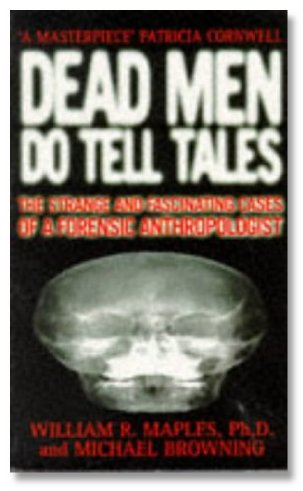
From a skeleton, a skull, a mere fragment of burnt thighbone, prominent forensic anthropologist Dr. William Maples can deduce the age, gender, and ethnicity of a murder victim, the manner in which the person was dispatched, and, ultimately, the identity of the killer.In Dead Men Do Tell Tales, Dr. Maples revisits his strangest, most interesting, and most horrific investigations, from the baffling cases of conquistador Francisco Pizarro and Vietnam MIAs to the mysterious deaths of President Zachary Taylor and the family of Czar Nicholas II.
|
|
|
| |
Most Helpful Customer Reviews:
Add Your Own Review |
 Bones tell no lies: the case file of a forensic anthropologist, March 15, 2016 Bones tell no lies: the case file of a forensic anthropologist, March 15, 2016
By Melissa Embry
|
|
Before there was "Bones," even before "CSI", in the days when DNA evidence was still on the far frontiers of science, forensic anthropologist William R. Maples was bringing criminals to justice, clearing the innocent, and give names to the nameless dead simply by examining the structure of human skeletons. In his 1994 memoir, "Dead Men Do Tell Tales," co-written with journalist Michael Browning, Dr. Maples describes his career arc from an English literature undergraduate in the 1950's, paying his way through college by recovering the bodies of accident victims for a local funeral home, to his work in the 1970's through the mid-1990's at the C. A Pound Human Identification Laboratory of the Florida Museum of Natural History.
The museum, Maples wrote, was charged by law to "provide assistance to the state in the 'identifying specimens.' I doubt the original framers of the law imagined that among those 'specimens' would be human remains, still less that those remains would be the ghastly leavings of murderers and maniacs."
If there seems to be a certain gleefulness in Maples' description, chalk it up to the "combination of good luck and bad character" he says caused him to change his major in the last semester before his graduation at the University of Texas from English to anthropology. He had become interested in anthropology when as a freshman, his adviser suggested taking an anthropology class in place of the one he wanted, whose registration was already filled. Changing majors in his last year required a course in advanced physical anthropology taught by UT newcomer Tom McKern.
McKern had already assisted in identifying the remains of American soldiers killed in World War II and Korea. After Maples' first discussion with McKern, "a conversation that lasted half an hour at most. . . I knew what I wanted to do with my life."
That life would include (at the urging of his wife) traveling to Kenya for a research project on baboons (both of their daughters were born in Kenya, and Maples cherished memories of the country until his death in 1997); identifying cremated remains both for relatives suing a funeral home and law enforcement forces in a two-state multiple murder-suicide case; and assisting with the identification of the remains of murdered Russian Tsar Nicholas II and his family. In between were days spent excavating the victims of drug deals gone bad, identifying bodies mutilated both by their murderers and subsequently by sharks or alligators, and determining whether a host of solitary bodies found in Florida's jungle-like undergrowth died by their own hands or at those of others.
For those who fear the journey will prove too gruesome, Maples leads his readers through the horrors with cool and compassionate eyes that could see "bones of martyred innocents, and bones of double-eyed murderers, all lying side by side, equal and silent beneath the impartial eye of science. . . victims and murderers alike area people."
The epigraphs of the book's chapters quote poets and historians, journalist/soldier Ambrose Bierce and a Soviet ambassador, and plentiful photographs of appropriately sanitized bones let readers test their observations against those of Maples and his fellow researchers.
Maples ends with a plea for more resources devoted to forensic anthropology, a plea even more pertinent twenty years after the writing, when state governments are famously asking whether we really need any more anthropologists.
Was this review helpful to you?
|
|
|
|
 an easy read and very interesting, March 05, 2016 an easy read and very interesting, March 05, 2016
By maggie (0)
|
|
This book I also have for a forensic class and in fact some of an exam came directly from this book....an easy read and very interesting.
Was this review helpful to you?
|
|
|
|
Five Stars, February 21, 2016
By Spike97
|
|
Great book! An interesting and insightful book into the world of Forensic Anthropology!
Was this review helpful to you?
|
|
|
|
The Dead Do Talk, February 18, 2016
By SylJ - Amazon Customer
|
|
Very interesting. Dr. Maples is an expert in forensics & he takes you through years of his work in great detail. His descriptive narrative gives clear pictures making you feel like you are there looking on the crime scene or in the lab with him. I particularly liked the chapter on "Old Rough and Ready. "
Was this review helpful to you?
|
|
|
|
 so it works fine., February 10, 2016 so it works fine., February 10, 2016
By A Customer
|
|
This is not the same edition or cover as the one I recieved, but it's just for school, so it works fine.
Was this review helpful to you?
|
|
|
|
Not an "easy" read but worth it., January 21, 2016
By DTOM 1775
|
|
Not an "easy" read but worth it. Be advised that this book was written prior to universal access to DNA evidence. I'm unsure of the date it was published but it has a mid 1990's feel to it.
Was this review helpful to you?
|
|
|
|
See all 192 Reviews.
|
|
|
|


 (
(