|
|
|
|
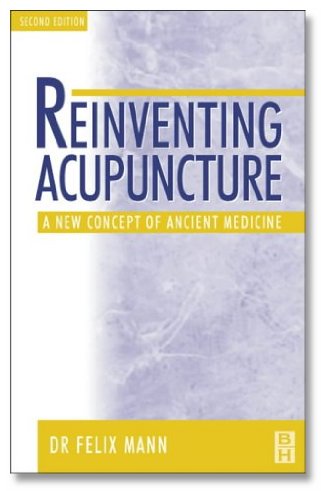
Reinventing Acupuncture: A New Concept of Ancient Medicine, 2e
|
 (2 Reviews) (2 Reviews)
|
|
|
Availability:
|
|
|
Published:
|
October 11, 2000 |
|
Binding:
|
Paperback
|

|
|
|
| |
Most Helpful Customer Reviews:
Add Your Own Review |
 Reinventing Acupuncture: A New Concept of Ancient Medicine, May 26, 2013 Reinventing Acupuncture: A New Concept of Ancient Medicine, May 26, 2013
By Michael Wong
|
|
The best acupuncture book I even read! Very down to earth. The acupuncture is a sensory stimulation that keeps your brain busy in receiving signals from skin nerve endings where needles inserted, eventually you forget the original pain or discomfort that bothered you.
1 of 1 people found the above review helpful.
Was this review helpful to you?
|
|
|
|
 Unimpressed so far, November 23, 2008 Unimpressed so far, November 23, 2008
By Quadradox
|
|
I am a physician, after having first been a researcher and a psychophysiologist. I looked forward to exploring more modern concepts of accupuncture and some serious scientific inquiry into how it works or doesn't work. This however is outdated (1992) and the author has quite an oversized ego evident from the beginning and persisting at least through the the first 3 chapters. His ego trip is becoming a barrier to maintaining an open mind. I am losing interest. Even from his own account of the conflict, he is starting to make me wonder if those who disagree with him might be right.
I do appreciate his honesty in stating what he hasn't tried. However, from there I am frustrated.
For someone who claims to have the inside track on research, he provides little or no evidentiary details for his assertions. He mostly tries to represent himself as the wise debunker of all the unnecessary traditional beliefs in points, meridians and methods for enhancing further stimulation of needling. So we apparently don't need to bother with accurate point location, electrical stimulation, moxibustion,etc.
Admittedly dropping these traditions could be a lot more convenient. Instead he prefers to keep it simple by inserting deeper, twisting and finding the threshold for no gain unless there's pain.
As a person training to perform acupuncture and as the prior recipient of many sessions of it by different practitioners-- I am getting a bit skeptical about applying his ideas without solid data. I'd actually prefer my acupuncturist has at least some investment in choosing locations wisely and avoiding unnecessary pain when possible. I may be wrong here, but it seems logical that bones are buried deeply beneath a lot of tissue because they might prefer to minimize most external contacts, particularly those which are pointed or frankly sharp.
So...I don't know yet. I may have to wait until further in my training experience to optimally assess his book. There is a chance he may be right. Nonetheless, he has not provided sufficient evidence-based material. Instead I found mostly indidvidual case comments not sufficienty developed to actually "call" them much less publish them as case studies, tightly packed with lots more of his strongly held opinions rather than data.
Just like the traditional schools which he no longer wants to take on faith or authority...he asks that I, the reader, take his word based on authority -- presumably because he is the author of other textbooks and devised an international nomenclature for points (which indicidentally he no longer believes in and has been subsequently revised by the World Health Organization by people he apparently regards as downright foolish.)
Bottomline: I haven't read anything in his book so far that qualfies as evidence-based, except evidence for too many requests to take his word for it. Like the "Chinese Masters" he now challenges, as more years pass between his stature as THE classic textbook author and THE early definer of one nomenclature system he now discredits, his writing will hold less credibility for many of us if the ratio of opinion to solid data continues to be this high.
He could do better, obviously ... if he is indeed this passionate about debunking the old myths and in persuading new generations of medical acupunturists to sell their patients on enduring deeper pain, to-the-bone pain, in order to relieve their pain.
14 of 22 people found the above review helpful.
Was this review helpful to you?
|
|
|
|
|
|
|