|
|
|
|
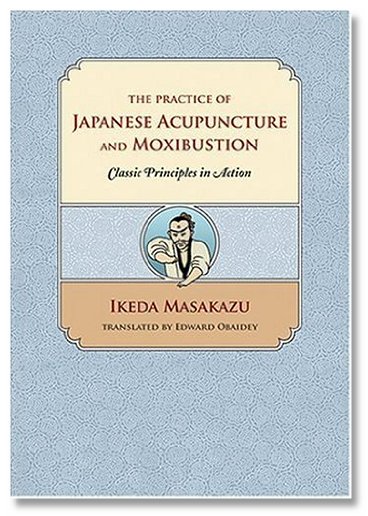
The Practice of Japanese Acupuncture and Moxibustion: Classic Principles in Action
|
|
By Ikeda Masakazu
|
 (8 Reviews) (8 Reviews)
|
|
$45.00
|
|
|
Availability:
|
Available for immediate delivery.
|
|
Publisher:
|
Eastland Press
|
|
Published:
|
February 28, 2005 |
|
Binding:
|
Paperback
|

|
|
|
| |
Most Helpful Customer Reviews:
Add Your Own Review |
 are very good book, but you need in first step read ..., January 30, 2016 are very good book, but you need in first step read ..., January 30, 2016
By A Customer
|
|
For me, are very good book, but you need in first step read or study some classic books or your school need to pass the basic, in my opinion. Really I saw the "classical in action", but the contet required a lot of time to study and think and surch in classic books.
It's very simple form, but requer to keep up your knowledge.
Was this review helpful to you?
|
|
|
|
Unique and useful, August 30, 2015
By A Customer
|
|
Good information that is not available in other books. In his first look my husband found a solution for a client with a very unusual problem who had not been helped by any other methods. Maybe that was a fluke but it was a tremendous help for this particular person, and worth the investment for her even if nothing else comes of reading it -- but we have high hopes.
1 of 1 people found the above review helpful.
Was this review helpful to you?
|
|
|
|
I want to hug Ikeda Masakazu., June 10, 2014
By V
|
|
I bought this book as required reading for a Japanese Meridian Therapy class and it was worth every penny. Masakazu shares case studies from his own clinical experience to bring to life the patterns he describes throughout the book. This is a great basic book for understanding meridian therapy.
Was this review helpful to you?
|
|
|
|
Great book on Japanese acupuncture., February 17, 2014
By jg_SD (San Diego, CA United States)
|
|
pros...this was one of the books that really gives a good insight into the world of Japanese/Meridian acupuncture. For those of you out there, there are different styles of acupuncture in the world. Japanese or Meridian acupuncture is more based on the very classic Chinese acupuncture. Most schools here in the US teach a very different style of acupuncture, called Zang/fu which is more based on organs and has a Chinese herbal slant. While the Japanese or Meridian style is based on meridians or lines of energy vs. the organs.
But you can't go wrong with this book, with either style of acupuncture you do. Well at least if you are a pragmatist like myself. I like to find the good and useful and integrate it into my treatment style. I find that the point location and point combinations are very different from Zang fu style acupuncture. Of course if you understand what I'm talking about then I hope you can appreciate the knowledge that is stored in the book. And they have really cool and memorable drawings in the book which help with understanding the concepts.
cons...not much. Sometimes a bit difficult to get, but well worth the price and the knowledge inside. Lots of clinical pearls of wisdom inside.
Was this review helpful to you?
|
|
|
|
 Meridian therapy, November 07, 2013 Meridian therapy, November 07, 2013
By Disappointed (San Francisco, CA)
|
|
To be honest the principles make very little sense to me, it's not presented in a very organized manner. The needling methods should be more clearly explained, such as when to use kyutoshin or tonetskyu or chinetskyu. The diagnoses also don't make a lot of sense, in particular when it comes to diagnosing exterior conditions. I like the five element principles and the notion that everything comes from deficiency, but in chinese medicine you always clear the excess (such as damp, heat, etc) before you treat the underlying deficiency so the treatment is more effective. In meridian therapy the focus is all on the deficiency, then you clear the excess. This is a method that doesn't make sense to me. Also no use of the eight extra meridians, or influential points (such as UB 17, GB 39). While meridian therapy is based on the classics, it's still a relatively new therapy. I feel having read the classics that meridian therapy is based on its interpretation on the classics, and not entirely on the classics. Chinese medicine can say the same about being based on the classics, yet meridian therapy gurus will tell you that it's not. I don't care for this war between the two, both therapies have a lot of merit and can have a good effect on the treatment. I thoroughly enjoy watching Ikeda Sensei work, and I while I feel his therapy is unique, I still feel that he is using Chinese Medicine principles. I like the emphasis of touch and palpation, the emphasis of needling and moxa technique rather than on the points themselves, the notion of 'less is more', the abdomen diagnosis, all these principles I will take away into my practice. But everything else I'm pretty sure I'm going to stick to TCM.
Was this review helpful to you?
|
|
|
|
 Good for consideration, October 17, 2013 Good for consideration, October 17, 2013
By -S (USA)
|
|
I first read an excerpt of this book on the publisher's website, which made it seem very clear and great for learning. However, when I got the book it wasn't as clear as I would have hoped. The theory was interspersed all throughout the book, instead of in the beginning or in a clear sort of order (and the introduction wasn't nearly thorough enough). I couldn't make sense of how to put it to good use...for instance, my personal pulse and hara diagnosis doesn't match any of the patterns. So I felt like the information was limited and at times contradictory. Attempting to understand the underlying mechanics was near impossible for me, personally. So it's good to view this book as it is: something which seasoned Japanese acupuncturists can read for their consideration. It might be useful in that regard. I don't think it's a textbook, or conducive for learning. It probably doesn't help that it's a translation from Japanese...that makes it a bit awkward to read.
Was this review helpful to you?
|
|
|
|
See all 8 Reviews.
|
|
|
|